
There are no residents, but the village is alive
Bendrinti
An oasis in the middle of a forest – this is how Inkūnai village could be described, located 25 kilometres north of Anykščiai, nestled on the left bank of the Šventoji river and belonging to Anykščiai municipality. On a weekday, especially in bad weather, it is very unlikely to meet anyone in the village, as the old-timers have passed away and the new residents are just settling in. However, tourists looking for romance often visit the village, and pottery enthusiasts flock to "Amatų kalnelis" (Craft Hill).
Village surrounded by forest
Linguists derive the village name from the personal name Jankus, but according to the Anykščiai region place-name directory, the village name may also originate from the Latin word "incunabula", meaning swaddling clothes, birthplace, or infancy. Especially as a spring with the same name gushes near the church. Some Anykščiai residents even go there to fetch its pure water.
In any case, the village's roots date back to 1657, when it belonged to the Svedasai manor, ruled by the Radvilos, and later to the owners of the Morkūniškės and Drobčiūnai manors of Svedasai parish. In 1923, the village had 6 homesteads and as many as 42 inhabitants. Before the war, most of the village men worked as rafters, as there was a timber warehouse in the village and rafters floated logs down the Šventoji river all the way to Kaunas.
After the war, the village was incorporated into the Pushkin collective farm, later belonging to the J. Biliūnas collective farm, and the Mikieriai forestry district of Anykščiai forest enterprise.
According to Eugenijus Pajarskas, the elder of Anykščiai municipality, there are no longer any local residents in the village, but it is visited by people originating from this region and holidaymakers. "A peaceful forest heart," the elder said about Inkūnai. "People from the scattered villages in the Šimonys and Romuldava forests are still buried in Inkūnai cemetery; tourists are drawn to the wooden church on the hill, the spring, and the only suspension bridge in Anykščiai district over the Šventoji, connecting Inkūnai with Mikieriai, and the recreation areas by the river. The pottery workshop 'Amatų kalnelis', which is being established in Inkūnai, is also becoming a popular place in this village. We are repairing the forest paths leading to Inkūnai and tidying up the cemetery as much as we can."
The guardian of the village spirit has passed away
Until 1937, the village belonged to Svėdasai parish, and then for 2 years to Andrioniškis parish.
Thanks to the initiative and support of Anelė Šukienė, a resident of Inkūnai, a parish was established in Inkūnai just before the war, and the Church of Our Lady of the Gates of Dawn was built, which was consecrated in the autumn of 1942 by Bishop Kazimieras Paltarokas of Panevėžys. Two years ago, her daughter, also Anelė, passed away.
The homestead still shines with white windows and exudes the tranquility of the old village. In the garden, as many years ago, flowers bloom, and vegetables grow in cultivated beds at the end of the mown yard.
One of Anelė's daughters, Aldona, greeted us in the yard. Jūratė and Aleksandra, though living far away, are also frequent visitors to this homestead. "My mother died at home, she wouldn't come to live with us for anything," said Aldona, who works as a doctor in Panevėžys. "How many people crossed the threshold of this house! After all, my mother not only looked after the church but also prepared lunches during the indulgences. It's quiet and peaceful here. I feel good here. I go to the cemetery, stand there, and talk to the people dear to me who rest here."
According to Aldona Šukytė, her family's life was not easy. Her parents were exiled, and after their return, the Soviet authorities did not look kindly on them for nurturing the church…
The Inkūnai parish is administered by Virginijus Taučkėla, the priest of Andrioniškis. The church surroundings are adorned with the Memorial Park, established on the initiative of Valentinas Šapalas, the chairman of the Inkūnai community. It features wooden carvings by famous folk artists, erected in memory of still existing and already vanished surrounding villages.
Incidentally, next to the church, the unused building of the former rectory is decaying. Not long ago, children from camps for children seeking faith and truth, founded by priest Salvijus Pranskūnas and writer Vanda Juknaitė, used to frolic and enjoy life in the middle of the forests there. "They were so sensitive and shy," A. Šukytė recalled. "They would come to buy milk or vegetables, but they wouldn't go inside, they would call my mother from the yard." However, the building is now abandoned. Rumors are circulating that authorities forbade organizing camps for street children here due to sanitary conditions.
The well-maintained homestead of the deceased Lukauskai family is looked after by the descendants of the old villagers who passed away, and they also keep bees there.
In place of the organist's little homestead – "Amatų kalnelis"
For many years, the abandoned house of Jonas Porcikas, the former organist of Inkūnai church, was an exotic spot for tourists visiting the village to gaze at the walls covered with "Tiesa" and "Kolektyvinis darbas" newspapers, or even to spend the night on the remains of wooden floors with the wind whistling through the window holes. This was the case until Renata Umbrasienė, a ceramist from Panevėžys, set her eyes on this hut a decade ago. "It, the hill, and the uniqueness of this place simply enchanted me," said R. Umbrasienė.
She bought the almost ruined and dilapidated house and rebuilt it. Then, several more buildings appeared on the homestead, with reed and straw roofs that blended so well with the local landscape. "I am almost a local, as I spend 3-4 days a week in Inkūnai," noted R. Umbrasienė. In her opinion, the road from Andrioniškis to Inkūnai is very bumpy and poorly maintained. It is damaged by owners cutting trees with heavy machinery, and there is no one to take care of it.
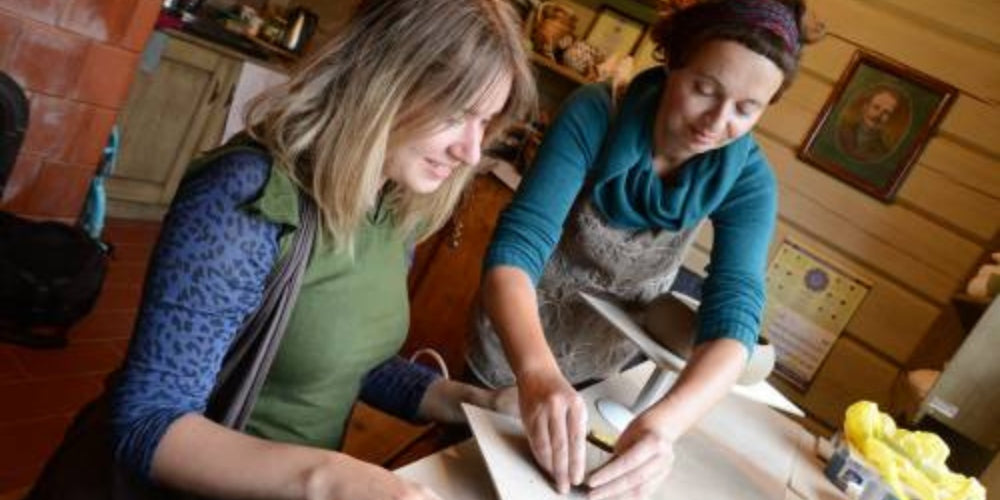
The hostess of "Amatų kalnelis" not only introduces guests to one of the oldest crafts in the world but also teaches them how to make a bowl or a whistle. Clay products are fired in an outdoor kiln.
Source of the article: https://www.anyksta.lt/gyventoj-nera-taciau-kaimas-gyvas/